


How Do You Style Artisan Furniture in a Minimalist Home?
Last Updated: November 2, 2026
Quick Summary
Style artisan furniture in a minimalist home by choosing one handmade piece as the focal point and surrounding it with a neutral palette. Keep the rest of the room quiet, respect scale and walking clearance, and resist filling empty space with accessories.
Choose one handmade piece, such as a dining table or statement chair, as the focal point.
Build a neutral palette of warm whites, soft grays, sand, or stone around the wood.
Keep rustic elements to one or two per room to avoid tipping into cabin style.
Leave at least 36 inches of walking clearance around a dining table.
Treat empty space as part of the design and remove one object for every one you add.
Table of Contents
Why Artisan Furniture Works in a Minimalist Home
Minimalist rooms can feel cold when every surface is bare and every object is new. That is where handmade furniture earns its place. At Richard Gentry Designs, we have spent more than 25 years building custom wood pieces for Nashville and Middle Tennessee homes.
Artisan furniture is handmade wood furniture built by a single maker or a small shop, usually with joinery and finishing methods that show the hand behind the work. In a minimalist home, that visible craft does the job that ornament would otherwise do.
Here is the core idea. Minimalism removes clutter, but it does not remove character. A solid walnut table gives the eye something to rest on, so the room feels intentional instead of empty.
The steps below walk through how to do this in practice, room by room, with a focus on the decisions that most guides skip.
Step 1: Choose One Handmade Piece as the Focal Point
Start with one piece that deserves attention. A dining table or a statement chair works well. Pick the piece you would notice first when you walk in.

Many homeowners try to make every item handmade. That usually backfires. When five pieces compete for attention, none of them stands out.
Quick checklist for choosing a focal piece:
It is the largest or most visible wood piece in the room
The grain or joinery is worth looking at up close
It has clean, simple lines that match the room's restraint
The rest of the room stays quiet around it
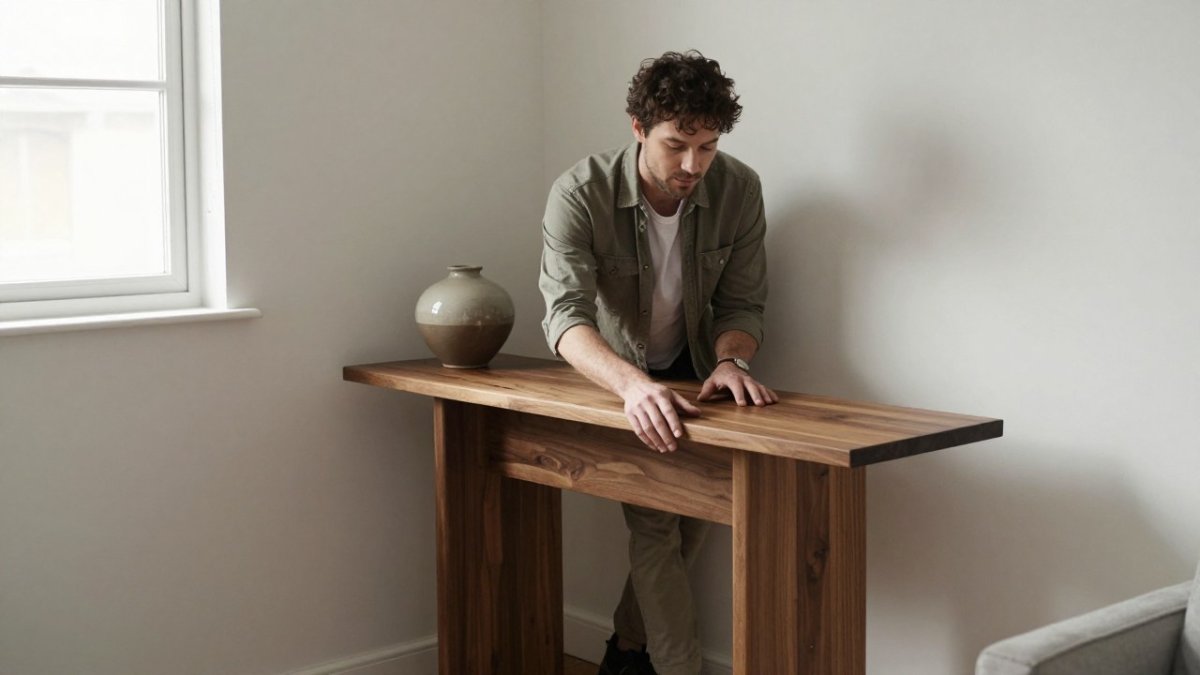
A solid walnut dining table with clean lines is a classic choice. Our Oval walnut dining table and Ash minimalistic modern dining chairs are examples of pieces that work as a focal point. You do not need ornament when the material is doing the talking.
Step 2: Build a Neutral Color Palette Around the Wood
Wood is already a color, so the rest of the room should support it. Choose a base of warm whites, soft grays, sand, or stone for walls and large fabrics. Then pick one or two accent tones pulled from the wood itself.
A simple way to test a palette is to hold a wood sample next to your wall paint and a fabric swatch. If the three look like they belong to the same family, you are on track. If one jumps out in the wrong way, change it.
Neutral does not mean dull.
Step 3: Balance Modern Silhouettes With Rustic Details
Artisan furniture often sits between two styles: modern lines and traditional craft. That mix is part of its appeal. A clean-lined table with a hand-finished top can sit beside a contemporary sofa without any clash.
To find the balance:
Pair one rustic element, such as a visible grain or worn edge, with modern forms
Keep the number of rustic pieces low, usually one or two per room
Let the simple silhouette lead, and let the texture add the warmth
Watch out: mixing too many rustic pieces in one space can tip the room into cabin style. If you already have a farmhouse table, choose modern chairs and simple lighting for the rest of the room.
Step 4: Get Scale, Proportion and Placement Right
This is the step most guides skip, and it matters most in minimalist spaces. Scale determines whether a piece looks intentional or crowded.
Rules of thumb for placement:
Leave at least 36 inches of walking clearance around a dining table
Allow 18 to 24 inches between a coffee table and the sofa
Keep a dining table's length roughly two-thirds of the wall it sits against
Hang or place art and lighting at a height that relates to the furniture, not the ceiling
These are common guidelines used by many interior designers, not fixed rules. Measure your room, tape out the footprint of a piece on the floor, and live with it for a few days before committing.
Custom pieces can be sized to the space. When a standard table is too long for a corner or a bench does not fit a window seat, a custom build can be made to fit.
The article's placement guidelines are easy to scan in the table below.
Placement item | Guideline | Note |
Walking clearance around a dining table | At least 36 inches | Common designer guideline, not a fixed rule |
Gap between coffee table and sofa | 18 to 24 inches | Common designer guideline, not a fixed rule |
Dining table length | Roughly two-thirds of the wall | Measure and live with it before committing |
Art and lighting height | Relates to the furniture | Not tied to the ceiling |
Step 5: Style Each Room Without Adding Clutter
Most guides stop at general principles. The decisions that make a minimalist room work depend on the size of the space, the traffic path, and the light. Here is a room-by-room approach.
Living room. Anchor the seating group with one handmade piece, a coffee table, a console, or a side table, and let the sofa and chairs stay visually quiet. A low, rectangular coffee table is one common pattern for this room. Keep the tabletop mostly clear: one book stack, one tray, or one object with a story. If the room has a fireplace or a large window, place the artisan piece so it reads as part of that sightline rather than floating in the middle of the floor.
Dining room. The table is the focal point, so the chairs should support it rather than compete. Pair a walnut table with ash or painted chairs, or repeat the same wood in a simpler chair profile. Center one pendant or linear fixture over the table, hung so the bottom sits roughly 30 to 36 inches above the tabletop. Leave ample walking clearance on the sides you use to pull out chairs. Resist the urge to fill the table between meals, a single low bowl or a pair of candlesticks is enough.
Bedroom. Choose a solid wood bed or a single bedside table as the artisan anchor, then keep bedding in a tight color range. Skip the stacked decorative pillow arrangement; one or two pillows in a texture that echoes the wood grain is enough. If the bed is the focal piece, keep the opposite wall simple so the eye rests on the frame and headboard joinery.
Home office. An artisan desk gives you a durable work surface and a visual anchor at the same time. Keep the desk surface to a lamp, a laptop, and one storage piece. Put paper and supplies in a closed drawer or a single lidded box rather than on open shelves, which read as clutter in a small room.
Entry or hallway. A small console or bench can hold one object, a bowl for keys, a single vase, or a framed print above it. Leave the floor and the rest of the wall open. In narrow entries, measure the console depth against the door swing before you buy.
Small spaces and rentals. In a compact apartment, scale down rather than skip the artisan piece. A handmade side table or a narrow console delivers the same warmth as a large dining table without crowding the room. For renters, freestanding pieces that do not require wall mounting are a practical choice.
Watch out: the most common mistake is filling empty space with accessories because the room feels unfinished. In a minimalist home, empty space is part of the design. Add an object only when it serves a purpose or carries a story, and remove one thing every time you add another.
Caring for Handmade Wood So It Lasts
Handmade furniture is built to last for decades, but the care routine depends on the material and the finish, not on a single set of rules. The guidance below covers the materials most common in artisan pieces, plus a short checklist for evaluating a piece before you bring it home.
Solid wood and handmade finishes. Solid wood moves with humidity, so keep pieces away from heat vents, radiators, and constant direct sun. Wipe spills promptly with a soft, slightly damp cloth and dry the surface. Ask your maker which finish product they used and how to maintain it.
Woven fibers and cane. Cane, rush, and woven seats dry out and crack in low humidity. Keep them out of direct sun and away from forced-air vents, and avoid soaking them during cleaning. A slightly damp cloth and a soft brush are usually enough; deep stains are best left to a professional.
Hardware and joinery.
Evaluating craftsmanship before you buy. A short checklist helps you judge whether a piece will hold up:
Look at the joinery: dovetails, mortise-and-tenon, or doweled joints signal a piece built to last; staples and screws alone are a warning sign
Check the grain: does it run continuously across a drawer front or a tabletop, or does it look mismatched?
Ask about the finish: what product was used, and how is it maintained?
Ask about provenance: where was the wood sourced, and who built the piece?
Confirm the dimensions and weight against your space and doorway before delivery
Sourcing and budget. Custom and small-shop work costs more than mass-produced furniture, but the trade-off is fit, material quality, and a piece made to your space. If budget is tight, a single well-made side table or bench delivers much of the warmth of a larger piece at a lower cost, and it can move with you to a future home. Ask makers about lead times before you commit.
Booking a Custom Piece for Your Minimalist Space
If you want a piece sized and finished for your home, the process usually starts with measurements, a sketch or photos of the room, and a conversation about wood species and finish. From there, a maker can estimate timeline and cost based on the scope of the work.
Custom furniture costs more than a standard piece from a retail store, but the trade-off is fit, material quality, and a piece made to your exact space. Our Real Walnut Farm Table, for example, is priced at $2,850.00, while our Ambrosia Dining Table is $6,500.00.
If you are thinking about a custom piece for a minimalist home, reach out to Richard Gentry Designs. We can help you choose the right focal piece, confirm the scale, and build something that fits the room as well as your style.
Frequently Asked Questions
What is the 3-5-7 rule in decorating?
The 3-5-7 rule is a styling guideline that suggests grouping decorative objects in odd numbers, typically three, five or seven, because odd groupings look more natural than even ones. In a minimalist home, apply it to small accents around a handmade piece, such as three objects on a walnut side table rather than four. Keep the total count low so the artisan furniture remains the focal point and the room does not feel crowded.
How many decorative objects should you place around a statement furniture piece?
Start with two to three objects around a statement piece, such as a custom farm table or a hand-built desk. Choose items with different heights and textures, for example a ceramic vessel, a stack of books and a small plant. Leave open surface area around the piece so its grain, joinery and finish stay visible. Add or remove one object at a time until the space feels calm rather than busy.
What colors work best with artisan wood furniture in a minimalist space?
Warm whites, soft greige, charcoal and muted earth tones pair well with walnut, ash, chestnut and other solid woods. These neutrals let the grain and natural color of the furniture stand out. Avoid placing more than one strong accent color in a room, and use texture in textiles, such as wool or linen, to add interest without adding visual noise.
Richard Gentry Designs builds custom, hand-crafted wood furniture for homes and offices across Middle Tennessee.
Comments