


7 Heirloom Furniture Pieces That Fit Small Spaces
Last Updated: November 21, 2026
Quick Summary
Heirloom furniture for small spaces works best when you choose pieces that earn their footprint, like round dining tables, demilune chests, slim desks, and wall-mounted beds. Solid hardwood, dovetail and mortise-and-tenon joinery, and a repairable finish define true heirloom quality. Measure walkways and the in-use footprint before you commission a piece.
A 42- to 48-inch round table seats four with no corners to clip a walkway.
A demilune console projects roughly half the depth of a full console.
Keep at least 30 inches clear on a main path and 36 inches where two people pass.
Tape the in-use footprint on the floor and live with it for a day.
Solid hardwood plus dovetail and mortise-and-tenon joints mark heirloom quality.
Will it actually fit your awkward corner?
We build custom wood furniture to your exact measurements and vision.
Table of Contents
7 Space-Saving Heirloom Furniture Types That Earn Their Footprint
Multifunctional Furniture for Small Spaces: Where One Piece Does Two Jobs
Furniture for Small Spaces Living Room: What to Choose and What to Skip
Small-Space Dining Table Ideas That Seat a Crowd in a Corner
Measuring and Spatial Planning Before You Commission a Piece
Why Heirloom Furniture Still Works in a Small Home
Heirloom furniture for small spaces sounds like a contradiction. Heirlooms are supposed to be massive oak dressers and farm tables built for a different era of housing. Yet the pieces that survive generations are rarely the biggest ones.
At Richard Gentry Designs, we have spent more than 25 years building custom wood furniture for homes across Nashville and Middle Tennessee, and the requests we get most often come from people in condos and smaller houses who cannot find well-made pieces at retail.
Below, we break down what actually makes a piece heirloom quality, seven space-saving furniture types that earn their footprint, and how to plan a custom piece before you commit. The throughline is simple: in a small home, quality and fit matter more than quantity, and a single well-proportioned piece beats three disposable ones.
What Makes Furniture Heirloom Quality
It is designed to be handed down, not replaced in five years.
That definition matters because "heirloom" gets used loosely in furniture marketing. A piece can look antique and still be particleboard under a veneer. The difference shows up in three places: the wood species, the joinery, and the finish.
Wood Species, Joinery, and Finish: What to Inspect
Start with the wood. If you want a deeper comparison of which species hold up best, our guide to the best wood types for long-lasting furniture walks through the trade-offs.
Then look at the joints. Dovetail drawers, mortise-and-tenon frames, and finger joints are the marks of a piece built to last.
Finally, examine the finish. A repairable oil or hand-rubbed finish can be refreshed in place. For a fuller checklist before you commit, see how to identify heirloom quality furniture.
7 Space-Saving Heirloom Furniture Types That Earn Their Footprint
The best heirloom pieces for a compact home are the ones that do a job without dominating the room. Here are seven types we build and recommend most often, each chosen for its footprint-to-function ratio, with the mechanism that makes it work and the trade-off you accept.
Round or oval dining tables. A 42- to 48-inch round table seats four with no sharp corners to clip a walkway, and an oval of the same width seats six along its length. The trade-off is wall clearance: a round table needs breathing room on all sides, so it suits an open corner better than a tight galley. A pedestal base instead of four legs frees up foot room and chair tuck-under.
Demilune and side chests. A half-moon console projects roughly half the depth of a full console against a wall, which keeps a hallway or entry passable. The trade-off is surface area: a demilune holds a lamp and a tray, not a full serving spread. Look for a back panel that sits flush so it does not gap against baseboards.
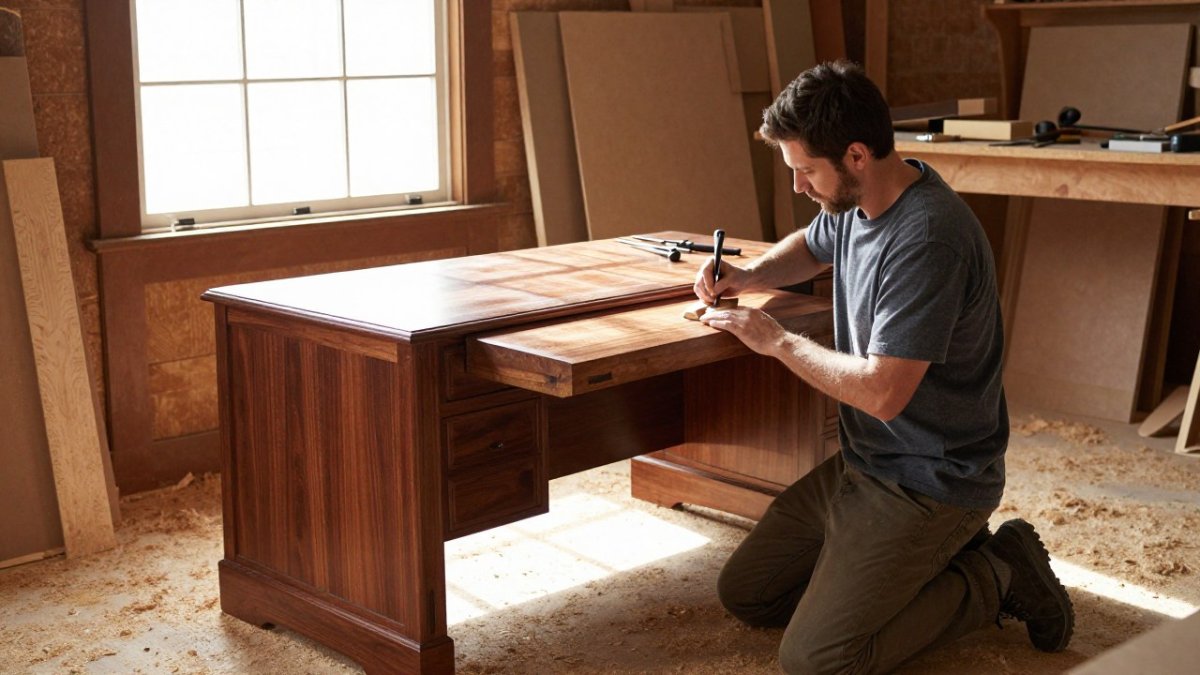
Writing and artisan desks. A desk 48 inches wide and 20 to 24 inches deep turns a corner or a wall segment into a workspace without a dedicated office. The trade-off is spread: a slim desk limits how many monitors and papers you can lay out, so pair it with a wall shelf or a file chest rather than a wider top.
Nesting and oval side tables. Two tables that tuck together cover a sofa end and a reading chair, then separate when guests arrive. The trade-off is stability: nesting tables are lighter by design, so check that the joints are mortise-and-tenon rather than doweled if they will see daily use.
Storage chests and credenzas. A credenza 60 to 72 inches long and 16 to 18 inches deep holds media, linens, or dishes while doubling as a landing surface. Vertical storage keeps clutter contained. The trade-off is height: a tall chest crowds a low ceiling line, so keep the top below the window head in a small room.
Furniture-style cabinetry. Cabinetry built in the style of furniture can add storage without a large footprint. The trade-off is that a built-in style piece is less flexible if your layout changes.
A Murphy-style or wall-mounted bed. The single biggest space-saver in a studio or guest room, because it returns the floor to living space during the day. The trade-off is the mechanism: the lift hardware and the wall anchoring carry the load, so specify a frame built to accept the hardware rather than retrofitting a standard bed.
Pros and Cons of Each Style in a Small Footprint
Every one of these has a trade-off. Round tables soften a tight room but waste a little wall space. Demilunes save floor area but offer less surface than a full console.
The honest answer: match the piece to the room's real constraint. If circulation is the problem, go round. If storage is the problem, go vertical.
Here is how the seven space-saving heirloom types compare on size, function, and trade-off.
Piece | Size or footprint | Trade-off |
Round or oval dining table | 42- to 48-inch round seats four | Needs breathing room on all sides |
Demilune and side chests | Roughly half the depth of a full console | Holds a lamp and a tray, not a full spread |
Writing and artisan desks | 48 inches wide, 20 to 24 inches deep | Slim top limits monitors and papers |
Nesting and oval side tables | Two tables that tuck together | Lighter by design, so check the joints |
Storage chests and credenzas | 60 to 72 inches long, 16 to 18 inches deep | Tall chest crowds a low ceiling line |
Furniture-style cabinetry | Adds storage without a large footprint | Less flexible if your layout changes |
Murphy-style or wall-mounted bed | Returns the floor to living space by day | Lift hardware and wall anchoring carry the load |
Multifunctional Furniture for Small Spaces: Where One Piece Does Two Jobs
Multifunctional furniture for small spaces is the category where custom work pays off most. A standard piece does one thing.

A storage chest that doubles as a bench. A desk that closes to become a console. A dining table sized to seat four but narrow enough to walk past.
We build pieces like our Artisan Desk in Flame Walnut for exactly this reason: a single well-made desk can anchor a whole room.
Furniture for Small Spaces Living Room: What to Choose and What to Skip
Furniture for a small living room should prioritize visual weight over raw size. A heavy, dark, oversized sofa shrinks a room even if its footprint is modest. A lighter, well-proportioned piece opens it up.
Choose: slim side tables, a demilune console against the longest wall, a low-profile coffee table, and one statement piece rather than several mid-size ones. Skip: oversized sectionals, tall bookcases that crowd the ceiling line, and matching sets that make a small room feel like a showroom.
If you are furnishing a compact living room and want concrete alternatives, our guide to bespoke furniture alternatives for small living rooms compares custom, modular, and off-the-shelf routes. Our olive ash burl coffee table is a good example of a low, visually light centerpiece that does not overwhelm a small footprint.
Small-Space Dining Table Ideas That Seat a Crowd in a Corner
Small-space dining table ideas work best when the table shape matches the room shape. A round or oval table in a corner seats more people with less wall length than a rectangle. An extension table handles the holiday crowd and then folds back down.
Our 1800's Chestnut extension farm table solves the classic problem: a table that seats two day to day and six when family visits. If you are unsure what size fits your dining corner, our guide to choosing the right table size for dining rooms walks through the measurements before you order.
Measuring and Spatial Planning Before You Commission a Piece
Measuring is where most small-space furniture purchases go wrong. The piece arrives, and it fits the wall but not the walkway. Before you commission anything, measure the room, not just the wall, and plan for the space the piece occupies in use, not just its footprint.
The Measurements That Actually Matter
Wall length and available depth, including baseboards. Baseboards and crown molding eat an inch or more, so measure from the finished wall face, not the stud.
Walkway clearance. Mark the path people actually walk, then subtract it from your usable depth. A common pattern is to keep at least 30 inches clear on a main path and 36 inches where two people pass; below that, a room feels pinched even when the furniture technically fits.
Ceiling height and obstructions. Note soffits, window ledges, and the bottom of any wall cabinet that limits a tall piece. A tall chest that crowds the ceiling line shrinks a room visually.
Judging Visual Weight, Not Just Square Inches
A piece can fit the tape measure and still overwhelm the room. Visual weight is the impression of mass a piece carries, and it is driven by color, height, and how much solid surface faces the walkway. A dark, tall, solid-front chest reads heavier than a lighter, lower piece of the same footprint. Open legs and a visible floor line under a piece make it read lighter than a solid plinth.
Planning for Use, Not Just Placement
Measure the piece in its working state. A dining table needs chair pull-out on the sides people use, so add roughly 30 inches of clearance per seating side to the table's footprint.
This step is where custom furniture earns its keep.
Watch out: measuring the wall but not the walkway is the single most common small-space mistake, so tape the in-use footprint, not just the closed piece, before you order.
Start Your Custom Heirloom Piece With a Conversation
The hardest part of buying heirloom furniture for a small space is trusting that a custom piece will actually fit and last. We understand the hesitation.
We are glad to talk through your space, measurements, and vision before work begins. If you are ready to begin, here is how to prepare for a furniture design consultation so the first meeting is productive.
A small home does not have to mean disposable furniture. It means every piece has to earn its place, and a well-built piece earns it for decades.
Frequently Asked Questions
What makes furniture heirloom quality?
Heirloom quality comes down to materials and construction, not a label. Look for solid wood rather than veneer over particleboard, joinery you can see and feel (dovetails, mortise-and-tenon), and a finish that can be repaired instead of stripped. A piece earns the name when it can be sanded, re-glued, and refinished decades later. Ask how the frame is joined. If the answer is vague, the quality claim probably is too.
Can custom furniture be made for a small space?
Yes, and small spaces are often where custom work pays off most. Awkward corners, short walls, and narrow dining areas rarely match standard retail sizes. We tailor pieces to your specific design and size requirements. Bring measurements, photos, and a rough floor plan to the first conversation so the design starts from your actual room.
How can multifunctional furniture save space without looking bulky?
The trick is choosing pieces that convert rather than pieces that stack features. Choose pieces that convert rather than pieces that stack features. Skip anything with visible hardware clutter or thick folding mechanisms, which add visual weight. One well-built convertible piece usually serves a small room better than three single-purpose items competing for the same floor area.
What is the 2/3 rule for furniture?
The 2/3 rule is a sizing guideline: a major piece, such as a sofa or dining table, should occupy roughly two-thirds of the wall or open floor area it sits against, leaving visual breathing room on either side. In a small living room this keeps a large heirloom from swallowing the space. Measure the wall, divide by three, and use that as your upper limit. Pair it with clear walkway widths so the room still moves well.
Comments