


.png)

How to Style a Solid Wood Bed Frame: A Complete Guide
Table of Contents
Step 1: Assess Your Wood Tone and Finish
Bedroom Color Schemes With Wood Furniture
Step 2: Choose Bedding for a Wooden Bed Frame
Step 3: Coordinate Bedroom Furniture and Nightstands
Step 4: How to Make a Bed Look Classy With Layering
Styling a Minimalist Bedroom With a Wooden Bed Frame
Step 5: Balance Scale, Proportions, and Visual Impact
Frequently Asked Questions
Last Updated: October 13, 2026
Step 1: Assess Your Wood Tone and Finish
Learning how to style a solid wood bed frame starts with understanding what you're working with. Your wood's tone and finish determine every color choice that follows.
Solid wood comes in warm and cool undertones. Walnut leans cool and dark. Oak runs warm and medium. Chestnut sits somewhere between. The finish matters just as much as the wood species itself. A matte finish absorbs light and feels understated. A glossy finish reflects light and draws the eye. A hand-rubbed finish shows the wood's character and grain patterns.
Look at your bed frame in natural daylight. Notice how the color shifts throughout the day. Morning light reveals different tones than evening light does. This matters when you're choosing bedding and accessories.
At Richard Gentry Designs, we've worked with homeowners for over 25 years to match custom wood pieces with their spaces. The first question we always ask is simple: what does your wood actually look like in your room? Not in the showroom. In your bedroom with your windows and your light.
Write down three words that describe your wood's tone. Is it honey-warm? Deep and rich? Light and natural? These words become your color palette anchor.
Pro Tip Take photos of your bed frame at different times of day. These photos become your reference when shopping for bedding and accessories. Colors look different on screens than in person, so having true reference images prevents costly mistakes.
Bedroom Color Schemes With Wood Furniture
Your wood tone opens or closes certain color doors. Warm wood works beautifully with warm neutrals. Cool wood pairs with cool grays and soft whites.
Warm wood tones pair well with:
Cream and ivory linens
Warm gray bedding
Rust and terracotta accents
Gold and brass hardware
Warm white walls
Cool wood tones work best with:
Crisp white bedding
Cool gray textiles
Soft blue and green accents
Silver and chrome hardware
Cool white or soft gray walls
The mistake most people make is treating their wood as invisible. It's not. Your bed frame is the largest object in the room. It anchors the entire space. Every other color should work with it, not against it.
A neutral color scheme doesn't mean boring. Neutral means your wood gets to be the star. Add depth by layering different textures: linen, cotton, wool, and cotton blends. Mix matte and subtle sheen. Use pillows to introduce color without overwhelming the space.
If you want color in your bedroom, use it in small doses. A colored throw blanket. Patterned pillows. Wall art. These elements let you change your mood without redecorating your entire room.
Interior Design Society guidelines on color theory confirm that color harmony depends on understanding your dominant element, in this case, your wood frame.
Step 2: Choose Bedding for a Wooden Bed Frame
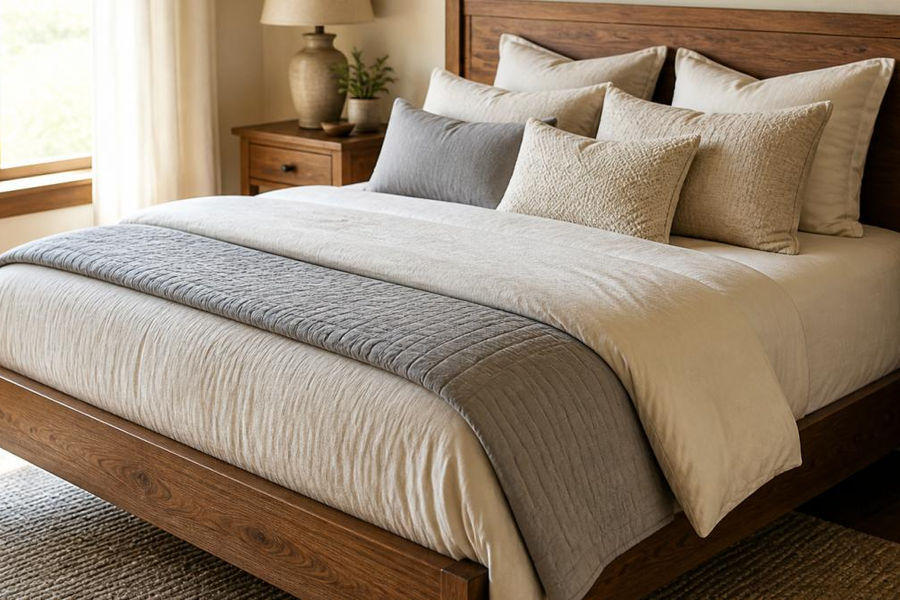
Quality bedding makes or breaks a solid wood bed. Cheap linens cheapen the entire look. Your bed frame deserves better.
Start with these bedding layers:
Fitted sheet in natural fiber (cotton, linen, or blend)
Flat sheet in the same natural fiber
Duvet cover or quilt in a complementary neutral
Decorative pillows in varying sizes
A throw blanket for texture and warmth
Natural fibers breathe better than synthetics. They feel better against skin. They age beautifully. Cotton sateen has a subtle sheen. Linen wrinkles intentionally and looks intentional. Cotton jersey feels like soft t-shirt material. Each has a different visual impact on your wood frame.
The thread count matters less than fiber quality. A 300-thread-count linen sheet outperforms a 1000-thread-count polyester blend every time. Look for long-staple cotton or European linen for durability.
Color choice depends on your wood finish. Lighter woods handle bolder bedding colors. Darker woods need lighter bedding to create visual balance. A dark walnut frame with crisp white linens creates drama. The same frame with cream linens feels softer.
Layering creates visual interest. A white fitted sheet, cream duvet, and warm gray throw tell a story. A single color top to bottom looks flat, even if the wood is beautiful.
Watch Out Avoid matching your bedding exactly to your wood tone. Wood-on-wood creates a muddy, undefined look. Your bed frame disappears instead of standing out. Always use lighter bedding on darker wood, and choose bedding that contrasts slightly with lighter wood frames.
Step 3: Coordinate Bedroom Furniture and Nightstands
Your nightstands set the tone for the entire bedroom. They don't have to match your bed frame exactly, but they should speak the same design language.
Top 120+ Wooden Bed Frame Design -- Modern And Rustic Bed Design -- Bed Design In Wood -- Bed Design
The Art of Craft
If your bed frame is a statement piece with visible grain and character, your nightstands can be simpler. Let the bed be the focal point. If your bed frame is minimal and clean-lined, your nightstands can introduce more detail.
Wood species don't need to match. A walnut bed frame works beautifully with oak nightstands, or with a mixed-wood nightstand that includes both. What matters is that the finishes complement each other. Matte with matte. Glossy with glossy. Hand-rubbed with hand-rubbed.
The height of your nightstands matters more than people realize. They should be roughly level with the top of your mattress, or slightly lower. This creates visual harmony and makes them functional for reaching items in bed.
A dresser or chest at the foot of the bed can anchor the space. It doesn't need to match your bed frame either, but it should feel intentional. A lighter wood dresser opposite a dark wood frame creates balance. A similar-toned dresser deepens the richness of the room.
Consider these nightstand options:
Floating shelves for a minimalist look
Open wooden tables for an airy feel
Closed drawers for storage and visual weight
Mixed-material stands with wood and metal
The spacing between your bed and other furniture matters. Leave at least two feet of walking space on each side of the bed. Your room should feel open, not cramped.
Step 4: How to Make a Bed Look Classy With Layering
Layering is what separates a made bed from a styled bed. It's the difference between functional and beautiful.
Start with your base layer: fitted sheet and flat sheet. These are your foundation. On top, add your duvet or quilt. This is your main color and texture statement.
Now add pillows. A standard pillow, then a euro sham (a large square pillow), then a decorative pillow. This creates height and visual interest at the headboard. Vary pillow sizes. A 20-inch pillow, a 26-inch euro sham, and a 12-inch decorative pillow create rhythm.
Add a throw blanket folded casually across the foot of the bed or draped over one side. This introduces a second texture and color. A quilted throw adds dimension. A knit throw adds softness. A linen throw adds elegance.
Don't overthink it. Your bed should look inviting, not like a display that you can't actually use. You should be able to pull back the layers and get into bed without moving everything.
The rule of odd numbers works here. Three pillows look better than two. Three textures (smooth duvet, quilted throw, knit pillow) look better than two. This isn't rigid, it's a guideline that your eye will confirm.
Key Takeaway A classy bed looks intentional but livable. Every layer serves a purpose: warmth, texture, color, or visual balance. Remove anything that doesn't contribute to the overall look.
Styling a Minimalist Bedroom With a Wooden Bed Frame
Minimalist bedrooms show you how to style a solid wood bed frame as the hero. Every other element supports it without competing.
Start with white or cream walls. This creates a clean backdrop. Your wood frame becomes the focal point. No competing patterns or bold colors.
Choose one accent color if you want it. Soft sage green. Warm gray. Dusty blue. One color, used sparingly. Maybe in a single throw pillow or a small piece of wall art.
Your nightstands should be simple. Open shelves or a single drawer table. Keep the surface clear except for a lamp and perhaps one small object. A book. A plant. Nothing more.
Bedding should be neutral and simple. White or cream duvet. White or cream pillows. Maybe one textured pillow in a natural fiber. That's it.
The minimalist approach works beautifully with wood because wood has so much visual interest already. You don't need to add more.
A single piece of wall art above the bed. A simple wooden chair in the corner. A small plant on a nightstand. These elements don't clutter. They breathe.
This approach also makes your room feel larger. Less stuff means more visual space. Your eye moves freely around the room instead of landing on multiple focal points.
Minimalism design principles from the American Society of Interior Designers emphasize that restraint creates impact. Your wood bed frame proves this principle perfectly.
Step 5: Balance Scale, Proportions, and Visual Impact
A solid wood bed frame has weight. It takes up space. It demands visual balance in the room.
If your bed is a low platform frame, your nightstands can be taller to compensate.
The size of your bed matters too. A queen frame in a small bedroom dominates the space. The same frame in a large bedroom might feel lost.
Large rooms handle bold colors and patterns better. A small room needs lighter, simpler styling. This isn't a rule, it's physics. Color and pattern take up visual space.
Ceiling height affects everything. High ceilings handle tall bed frames and tall headboards. Low ceilings work better with simple, simplified frames.
Wall space around your bed matters. If your bed is centered on a wall with space on both sides, you have flexibility.
A large mirror opposite your bed makes the room feel bigger. A piece of wall art above the bed anchors the space. A window with natural light makes everything look better.
Consider the visual weight of your room. A dark wood frame needs lighter walls and lighter bedding to feel balanced.
The goal is harmony. Your bed frame, your bedding, your furniture, your walls, they should work together, not compete.
Best For Rooms with high ceilings and generous floor space can accommodate statement bed frames with dramatic finishes and bold styling. Smaller rooms benefit from simpler frames and minimal accessorizing to maintain visual balance.
Styling a solid wood bed frame is about understanding your wood, respecting its character, and building a cohesive room around it.
When you need a custom wooden bed frame tailored to your exact space and vision, Richard Gentry Designs brings over 25 years of craftsmanship to the process. Every piece is hand-crafted to the dimensions and finish that make your bedroom exactly what you imagined. Fine Woodworking standards for furniture craftsmanship guide our process, ensuring every frame is built to last generations. SHOP
Frequently Asked Questions
What colors go well with a solid wood bed frame?
Neutral colors like cream, gray, and white create a clean backdrop that lets the wood's natural grain shine. For darker woods (walnut, chestnut), cool whites and soft grays work best. Lighter woods (ash, oak) pair beautifully with warm neutrals and soft earth tones. You can also introduce color through accent pillows or a throw blanket without overwhelming the frame's natural character. The key is letting the wood remain the focal point while adding depth through texture.
What bedding looks best with a wooden bed frame?
High-quality cotton or linen bedding complements solid wood frames beautifully. Choose a thread count of 300-600 for durability and comfort. Neutral-colored sheets (white, cream, gray, or soft taupe) allow the wood's beauty to stand out. Layer with a quilted duvet or coverlet in a coordinating tone, then add 2-3 decorative pillows in varying textures like linen, velvet, or wool. This layering approach creates visual interest and makes the bed look intentionally styled rather than simply made.
How do you style a wooden bed frame in a minimalist bedroom?
In a minimalist bedroom, let the solid wood bed frame be the focal point by keeping everything else simple. Use white or cream bedding, skip decorative pillows or limit to one neutral pillow, and avoid patterned textiles. Pair the bed with a simple wooden nightstand in a matching or complementary finish. Keep the wall behind the bed plain or very softly colored. This approach emphasizes the wood's natural beauty and grain while maintaining clean lines and open space.
Are wood bed frames in style for 2026?
Yes. Solid wood bed frames remain a timeless choice and are trending strongly in 2026. The shift toward sustainable, heirloom-quality furniture means wooden frames are increasingly preferred over mass-produced alternatives. Modern designs blend traditional craftsmanship with contemporary aesthetics, making wood frames work in minimalist, Japandi, rustic, and traditional bedrooms.
SHOP
Comments